



The Future Circular Economy
The circular economy is changing the way that CPG Brands in the Health Food industry operate.
Today, it is common to find restaurants announcing that their menu is limited due to supply chain disturbances. Many businesses are similarly affected as the perfect storm of supply chain interferences drastically affects the world economy. According to a recent analysis by Forbes Magazine, almost one-third of small businesses in the United States have reported that supply chain disruptions have significantly impacted their business. Another third report a moderate impact. Bloomberg News reports solemnly that “the bad news is that the world’s supply chain problems are more persistent and more severe than previously realized. The worse news is that there is no single reason why, and therefore no straightforward fix. And the even worse news is that no one really knows when the situation will improve.” The circular economy might be able to offer a way to deal with these increasingly serious supply chain issues. Some economic analysts may point to trade delays, higher energy and transport costs, and shortages of key technologies as the leading causes of the current supply chain disruptions. However, the current situation also invites us to take the opportunity to carefully analyze some of the root problems of our current global economic system and the inherent vulnerabilities that exist in a linear, extractive financial system that requires highly interdependent supply chains across wide geographic dispersion. The circular economy summons us to drastically rethink some of the fundamental elements of our globalized economic system. The Sheffield Political Economy Research Institute believes that “an ambitious circular economy, relying on narrower, slower, and shorter resource loops may help avoid future disruption." Beyond reducing vulnerabilities to supply chain disruptions, however, the circular economy offers practical solutions to several severe crises. This article will examine some of the difficulties with the linear, extractive economic model. We'll then analyze how the circular economic model is distinct and how it can respond to our serious financial challenges and vulnerabilities. Lastly, we'll explain a few different ways that health food brands in the consumer packaged goods (CPG) industry can begin to embrace the circular economic model.
The Problems with the Linear, Extractive Economic Model
Despite significant advances in the recycling industry, the globalized economy today is still dominated by a linear, extractive model, requiring an enormous complexity of corresponding parts. According to one recent estimate, around 61.1 billion tons of metal ores, fossil energy, and non-metallic minerals are extracted annually from the Earth. A further 20.5 billion tons of biomass is extracted to meet consumer demand and keep our economy growing. Most of these extracted materials follow the “take-make-dispose” economic model. According to this model, raw materials are mined or extracted, transformed or manufactured into products, and then discarded as waste in increasingly shorter intervals. The "make-take-dispose" model relies on volume to create value, where producing and selling as many products as possible is the foundational economic goal. Thus, planned obsolescence is essential to the "health" of the economy. In recent years, the unsustainability of this extractive economic model has been modeled by what is known as “Earth Overshoot Day.” This day marks the date when humanity’s demand for ecological resources and services in a given year exceeds what Earth can regenerate in that year. Whereas the date fell on October 23rd in 1987, this year it is almost three months earlier, on July 29th. Simply put, the "take-make-dispose" economic model is depleting the Earth's resources faster than they can naturally regenerate. It isn't rocket science to see that this is not a sustainable, long-term solution. Of course, our reliance on non-renewable resources such as fossil fuels is another severe issue. Economist Herman Daly states sums up the problem with this make-take-dispose model nicely: “Because of the exponential economic growth since World War II, we now live in a full world, but we still behave as if it were empty, with ample space and resources for the indefinite future. The founding assumptions of neoclassical economics, developed in the empty world, no longer hold, as the aggregate burden of the human species is reaching—or, in some cases, exceeding—the limits of nature at the local, regional, and planetary levels. The prevailing obsession with economic growth puts us on the path to ecological collapse, sacrificing the very sustenance of our well-being and survival.” Beyond the problems related to resource depletion and reliance on non-renewable resources to power our economy, the complexity of global supply chains is another vulnerability that should be considered. A 2013 study published by the Massachusetts Institute of Technology titled Uncertainty and Risk in Global Supply Chains states that “the globalization and fragmentation of supply chains create risk through interlinkages and interdependencies.” Studies estimate that processed food in the United States travels over 1,300 miles from where it is cultivated initially to where it is eventually consumed. Fresh produce travels over 1,500 miles before being consumed. Besides mere distance, however, the food that ends up on our table generally changes hands dozens of times throughout the process of transportation, manufacturing, packaging, marketing, distribution, and final retail sale. The same complexity in supply chains applies to virtually every other consumer product we purchase. Take the example of the computer or phone you use to read this article: The raw materials may have been sourced from the Central African Republic and Chile. The mining companies sold this natural material to an exporter who shipped the lithium and cobalt to a sub-subcontractor in Southeast Asia who began the primary manufacturing of the parts. The parts were shipped to a subcontractor for module production in China. These parts were then sent to the contract manufacturer for final assembly before being shipped worldwide to a contract logistics company involved in packaging and shipping to the retail stores where the computer was finally sold. For businesses, the vulnerabilities associated with global supply chains pose a severe risk to the health and resilience of the company. Even the most minor disruption along this long and complex supply chain could cause economic shocks. Furthermore, as more and more businesses attempt to adopt environmentally sustainable practices, the fact that up to 90 percent of companies’ impacts on the environment come from supply chains is further cause for concern. The circular economic model offers an opportunity to limit vulnerabilities while drastically reducing your company's environmental footprint.
What Makes the Circular Economy Different?
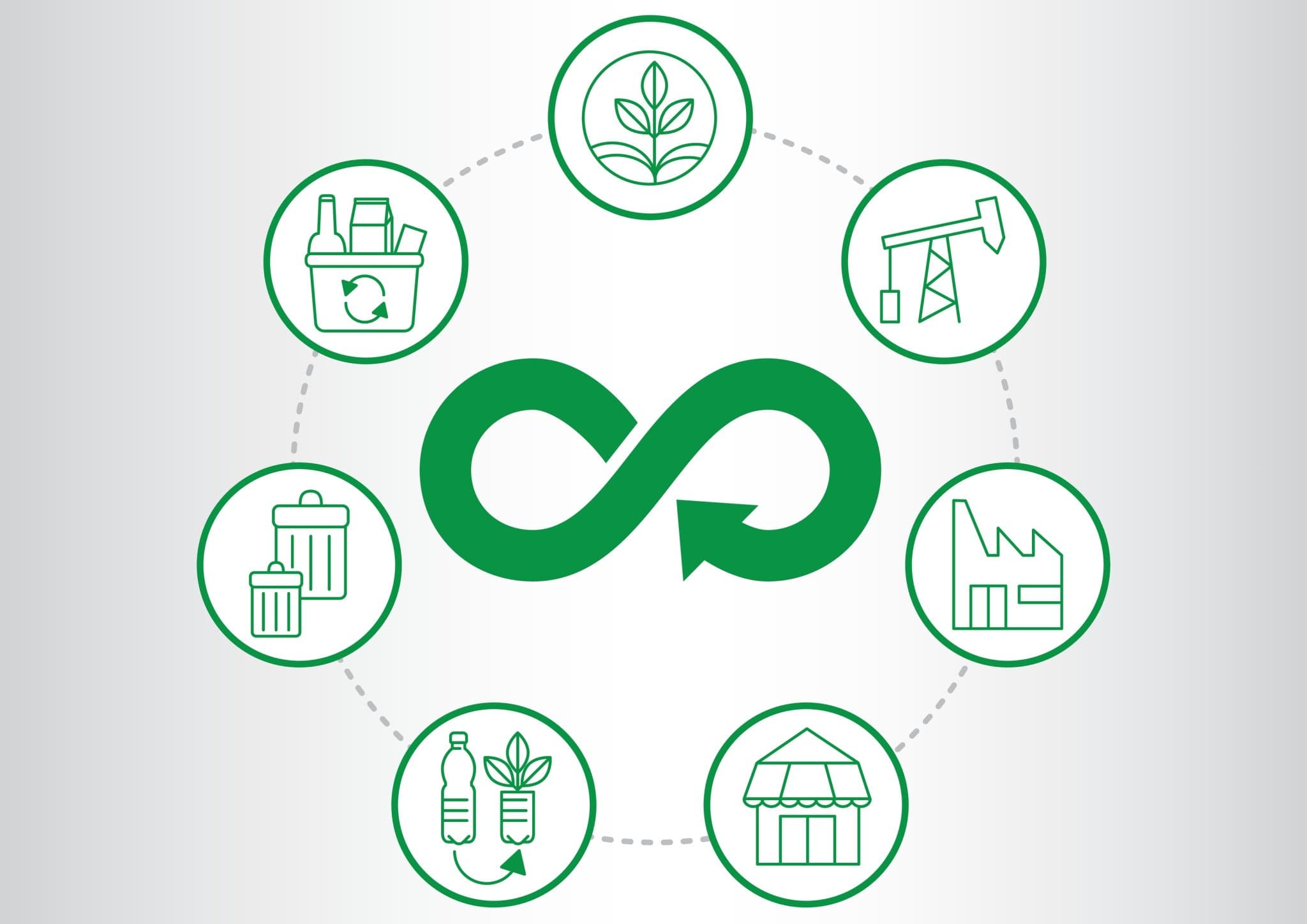
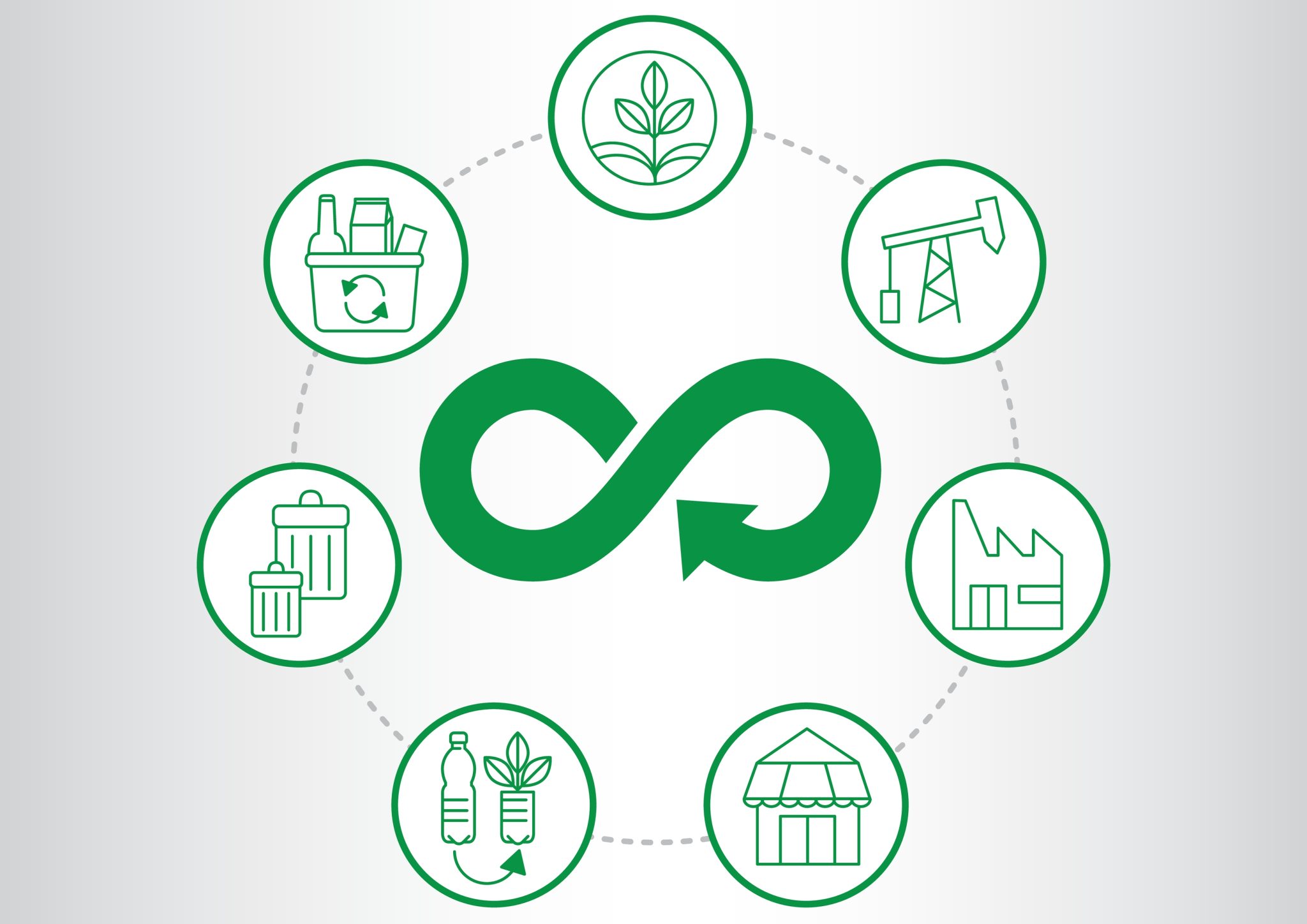
A circular economy is "a model of production and consumption, which involves sharing, leasing, reusing, repairing, refurbishing and recycling existing materials and products as long as possible." The ultimate goal of a circular economic model is to create a closed-loop system, thus decreasing reliance on resource inputs (especially from non-renewable resources) while reducing waste streams, pollution, and carbon emissions. Whereas the extractive and linear extractive model that dominates the global economy is dominated by planned obsolescence, the circular economic model aims to keep products, materials, equipment, and infrastructure in use for as long as possible. Rather than just focusing on recycling, the goal in the circular economy is for all waste materials and energy to be transformed into an input for other processes, either as a material for further industry manufacture or as a regenerative resource to be returned to the natural world. By focusing on manufacturing durable products from sustainably sourced resources and ensuring that all waste is circled through the economy as long as possible before returning to the natural world as a regenerative resource, the circular economy certainly offers solutions to the environmental problems posed by the linear economic model. Furthermore, a circular economic model might also help to reduce supply chain vulnerabilities leading to greater resilience. One recent study concludes that “the application of circularity principles implies a radical change in stakeholder relations, breaking with the "end-of-life" concept existing in linear economies. Furthermore, the circular economy can ensure resilience in supply chains and be considered a tool in uncertain environments.” The practical implementation of a circular economic model will differ depending on the industry, the geographic location of the business, and other contextual factors. However, the following key elements can help to guide the design of a circular economy model.
- Prioritize regenerative resources: The circular economic model does not deny that any economy will ultimately depend on land-based resources. Instead of extracting non-renewable resources in the most rapacious way possible, however, circularity focuses on using renewable and regenerative resources in the most energy-efficient manner.
- Stretch the lifetime: Raw materials manufactured into products must be maintained, repaired, and regularly upgraded to keep them functional and in circulation for as long as possible.
- Use waste as a resource: One person's trash is another treasure. There is a sustained focus on continually discovering ways to recover waste for reuse and recycling. In the circular economy, every effort is made to identify waste streams that can serve as a source of secondary resources for other economic actors.
- Team up to create joint value: Shifting to a circular economic model cannot be done alone, as this shift will require several businesses, organizations, and actors working together to eliminate waste streams. Companies attempting to shift to a circular economy must find like-minded partners throughout their supply chain, internally within their organization, and throughout the public sector. Communicating your shift to a circular economic model with the end customer is another strategy for success.
Businesses that embrace the circular economic model are also well situated to benefit from the increasing customer demand for more environmentally friendly business practices. A recent Deloitte survey found that almost one-third of consumers in the U.K. claimed to have stopped entirely purchasing products or services from companies or brands because they had ethical or sustainable concerns about how those companies operate. Furthermore, a 2019 survey discovered that 47 percent of internet users worldwide had ditched products and services from a brand that violated their personal values. Protecting the environment was at the top of that value list. The circular economic model allows businesses and brands to move beyond green-washing practices and to adopt an authentic commitment to sustainability across the supply chain. Consumers will likely be observant of companies who willingly make this transition.
Five Circular Economy Strategies for CPG Health Food Brands to Embrace the Circular Economy Model
For health food brands in the CPG sector, embracing a circular economic model makes sense on several levels. Generally, healthy food products begin with agricultural inputs produced in organic and/or regenerative ways, one of the critical elements of the circular economic model. Furthermore, many consumers of health food products share a genuine concern for the environment. This presents an opportunity to connect with consumers across shared ecological values, thus offering a chance to increase a loyal customer base. Below, we offer five practical strategies for health food brands to transition towards a circular economic model.
Strategy #1: Partner with Regenerative Producers at the Grassroots Level
Agriculture should be circular by nature. The soil, when managed correctly, can maintain its levels of fertility, as crop rotations, pasture rotations, and other soil husbandry practices return to the land what we take from it for our sustenance. Unfortunately, industrial agriculture of the past decades has essentially turned agriculture into an extractive industry. Consider the following:
- We are now losing about 1 percent of our topsoil yearly to erosion, most of which is caused by agriculture. The United States is losing soil ten times faster than the soil replenishment rate, while China and India are losing ground 30 to 40 times faster.
- Over 36 billion tons of soil are lost yearly due to water, deforestation, and other changes in land use.
- Over 1 billion pounds of pesticides are used in the United States annually, and approximately 5.6 billion pounds are used worldwide.
- Globally, about 25 percent of the total land area has been degraded. When land is degraded, soil carbon and nitrous oxide are released into the atmosphere, making land degradation one of the most important contributors to climate change.
If we don't change this extractive agricultural model, it is clear that we will run into the serious issue of simply not having enough fertile land to grow the crops we need to feed ourselves. Fortunately, regenerative agricultural practices can not only produce the food we need to survive but can also regenerate the land that has been degraded by industrial, agricultural production. Health food brands in the CPG sector should make a serious commitment to finding farmers, ranchers, and other producers who are embracing a regenerative agricultural model. This not only ensures that your customers will receive the most nutritious and nourishing food products free of the array of toxic chemical residues so prevalent today, but it also confirms your brand's commitment to the first essential element of circularity: prioritizing regenerative resources. Amazi Foods is one Paleo-certified health food brand that goes the extra mile to ensure that health food consumers trust that their food is ethically and sustainably produced by farming communities in Africa that embrace a regenerative agricultural model. According to their website: “We aim to go a step beyond ethical sourcing, supporting sustainable supply chains and creating connection through the production of our good-for-you snacks. How? We commit to keeping the production process in the country we source from. With every bite of Amäzi you take, you help close the gap between source and consumer, consumer and source.” This is a prime example of implementing a regenerative, circular model in your supply chain resources.
Strategy #2: Moving from Recyclable to Biodegradable to Reusable Packaging Materials
Another way that health food brands can begin to transition towards a circular economic model is through how they package their products. In the linear economic model, foods were regularly packaged with single-use plastics designed to be tossed away after consuming the product. As expected, this led to an enormous amount of packaging waste. According to one recent study%20was%20recycled%20or%20composted.), “in 2014, out of the 258 million tons of municipal solid waste generated in the U.S., more than 63 percent was of packaging materials (for food and other purposes) and, overall, only 35 percent (89 million tons) was recycled or composted.” In more recent years, brands have begun encouraging their customers to recycle the packaging they utilize. Though an improvement over simply landfilling, the recycling industry has been hit hard by the refusal of China and other Asian countries to accept millions of tons of U.S. post-consumer recyclables. In 2016, of the 16 million tons of plastic, paper, and metals the U.S. exported to China, at least 30 percent of these mixed recyclables were never recycled and polluted China's countryside and oceans. Given the problems with the recycling industry, many companies have also begun moving towards biodegradable packaging. Lesser Evil, a healthy snack food company, was the first snack brand to use biodegradable packaging. Their packaging contains an organic additive that, once discarded into a landfill, accelerates the natural microbial process by creating biogas which can be collected and turned into clean, renewable energy. However, an even more radical step towards circularity would be geared toward implementing reusable packaging materials. Reusable packaging not only drastically reduces waste but also follows the second key element of the circular economy: stretching the lifetime of a resource. Despite its novelty, major brands such as Calvin Klein and Patagonia are already implementing reusable packaging on a wide scale. In the second part of this article, we'll interview one of the leading companies helping brands transition to reusable packaging.
Strategy #3: Eliminate Food Waste from Production Practices
Health food brands should also consider how they can eliminate food waste from their production practices as part of a broader shift towards circularity. According to Project Drawdown, “a third of the food raised or prepared does not make it from farm or factory to fork. Producing uneaten food squanders a whole host of resources—seeds, water, energy, land, fertilizer, hours of labor, financial capital—and generates greenhouse gases at every stage—including methane when organic matter lands in the global rubbish bin. The food we waste is responsible for roughly 8 percent of global emissions.” Though CPG brands might not be able to stop food waste from occurring at the consumer level, some strategies can eliminate food waste from manufacturing. For brands that own their manufacturing facility, developing an on-site composting operation can allow you to turn any food scraps or food waste into valuable, fertile compost that can help to regenerate degraded soils. If you don't have the space for such an operation, you might also consider partnering with other organizations or businesses looking for "waste" materials. For example, Chip[s] Board is one innovative company that uses recycled potato peelings to make a new material that can be used instead of MDF or chipboard. The MDF-replacement material is biodegradable post-use and, unlike MDF, doesn't contain formaldehyde or other toxic resins and chemicals.
Strategy #4: Search for Partners
Finding other businesses and organizations to partner with is one of the critical challenges of the transition to circularity. Fortunately, new "connector" or networking organizations are beginning to pop up nationwide. For example, the Austin Materials Marketplace facilitates the exchange of waste materials between local companies by providing a platform to connect the supply and demand of secondary materials. According to one estimate, the platform successfully transferred almost a million pounds of waste in 2019, facilitating recycling and reuse around Austin, TX. Similarly, DeClique is a company in the Netherlands that uses cycle couriers and electric vehicles to collect food by-products like coffee grounds, orange peels, and other food waste from businesses. De Clique then sells these waste streams and by-products to third-party innovators and manufacturers, transforming them into new products like food ingredients, cosmetics, and biomaterials.
Strategy #5: Sustainable and Circular Manufacturing Processes
Lastly, health food companies should also implement sustainable and circular manufacturing processes. Installing solar panels or other forms of renewable energy generation in your business is one way. However, you might also look at ways to "stretch the lifetime" of the machines, tools, and other resources used in your manufacturing process. The snack food brand Lesser Evil has moved towards more circular manufacturing by owning its factory and manufacturing facility. This has allowed the company to take direct control of cleaning up the inefficiencies involved in production. They have installed an energy recovery ventilator that utilizes the hot air from the facility to melt oil instead of using any additional heating source. The company is also in the process of installing solar panels in its factory.
Conclusion
Besides making waste sexy, a transition to the circular economy is a great way to connect with environmentally-conscious consumers and an opportunity to construct more resilient supply lines. Soon, the circular economy may be the only way to run a successful company in a world beset by severe environmental problems and supply line shortages. Wayne Visser, the Director of the Sustainable Transformation Lab at the University of Cambridge Institute for Sustainability, says it well: “The only thing that’s enough is redesigning the industrial system – literally a new Industrial Revolution, closing the loop. This is no longer a dream, this is no longer a fantasy. We’re not talking about a utopia, we’re talking about something that is absolutely happening right now.”
Related Reading
Share: