



Food Programs Make It Hard for Parents to Pack Alternative Lunches
Dear Healthy Parents, I'm sorry I gave you such a hard time about sending your child to our childcare center with gluten and dairy-free lunches, Amino acid supplements, and halal meals that needed heating or your child with special needs wouldn't eat. I'm sorry that I wouldn't allow you to share those homemade date brownies with the class to celebrate your child's birthday. I could have been more understanding when you threw those cupcakes in the teacher's face, but she was only trying to...
*Dear Healthy Parents,*I'm sorry I gave you such a hard time about sending your child to our childcare center with gluten and dairy-free lunches, Amino acid supplements, and halal meals that needed heating or your child with special needs wouldn't eat. I'm sorry that I wouldn't allow you to share those homemade date brownies with the class to celebrate your child's birthday. I could have been more understanding when you threw those cupcakes in the teacher's face, but she was only trying to follow the rules. We were all just trying to follow the rules. I didn't understand the health benefits you were fighting for, I didn't truly understand the disrespect I was showing for your family's values, and I couldn't figure out how to balance my legal responsibilities and budget with your needs. Your child should have come first. Now that I have a child who gets asthma from dairy and headaches from gluten, I get that. If I could go back, I'd do it all differently. *Sincerely,*A Previous Childcare Director, but first a Mother
Fall is Here
I blogged before about 5 reasons school lunch programs are failing, now it's September, and for many moms like me that means it's time to get doctor notes and jump through 21 hoops to justify our decision to send kids to childcare, school and after-school programs with healthy lunches and snacks (special diets). The truth is, Food Programs Make it Hard for Parents to Send Healthy Alternatives to School and Childcare.
When I decided to take control of ManCub's nutrition all day, it was more difficult than filing taxes on April 14th. It required two different doctors, a medication form for our almond milk to be "administered" (no joke!) many guilt trips and snacks for an entire classroom. I provided multiple peer-reviewed research briefs and sent emails to the principal threatening to take more formal action if they couldn't monitor the "share table" to prevent a first grader with a dairy allergy from trading an apple for pizza. (Thankfully, ManCub FINALLY learned to self-monitor after getting sick a few dozen times)
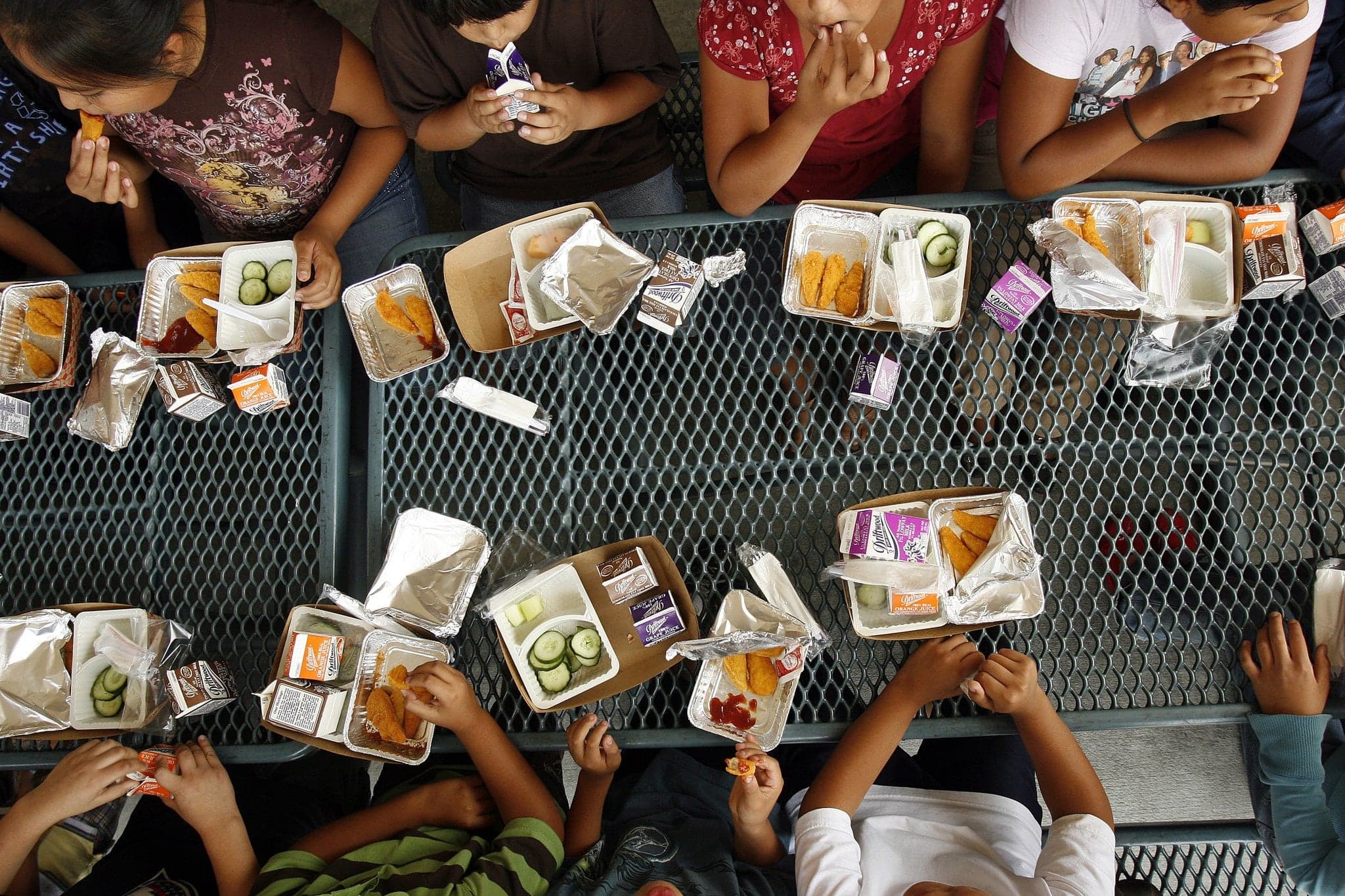
If your child's school or daycare participates in the National School Lunch Program (NSLP) or the Child and Adult Care Food Program (CACFP) you may have noticed they're exceptionally pushy. Ever wondered why the hard stance on fat-free cows milk at every meal? I directed a childcare center for a while and learned a lot as the administrator of the food program for my school.
Follow the Dollar
The USDA provides free food and subsidies to schools, childcare centers and adult daycare centers to provide meals throughout the day. The menu must meet USDA requirements for protein, grains, fruits and "vegetables" (Ya know, like pizza sauce?). Fluid cow milk must be served at all meals and children over two years old must drink fat-free or low-fat milk. Breakfast must include a grain product, fruit, and milk. Schools can add a protein, but only as an additional item (expense). In CACFP, the meal cannot be counted towards reimbursement without a grain, milk and fruit.
Center meal planning representatives are given one training on nutritional guidelines by USDA nutritionists and patted on the back for providing healthy meals for growing brains. When I attended my training ( to be fair, it was 2008, and things may have changed since then), it consisted of a notebook with guidelines. Most of the 4 hours was spent reviewing the paperwork for reimbursement and contractual responsibilities. Childcare centers who participate in the CACFP program create menus that are in line with USDA's guidelines and are allowed to claim up to $3.52 for lunches and $1.86 for breakfast and snack. Programs with evening hours can also serve a dinner It's not chump change. In my school, it added about $150,000 to my annual operating budget that was desperately needed. Hiring a kitchen manager who would comply with the guidelines was critical, and creating policies to require doctors notes for diet changes, and discouraging parents from bringing food from home became a necessary evil. (If I had known then what I know now, I might have handed all of this VERY differently!)
If a child has a food allergy and a doctors note, both programs can make appropriate substitutions and still receive reimbursement IF they still provide the food. If your dietary change is preference only, for religious reasons, or if you provide the food, the meal cannot be collected upon.
Milk must be served with the meal in order for the entire meal to be counted, and two brands of soy milk (who paid the money for research to show equivalency) are the only acceptable substitutions. Now you see the motivation to get your kid to the milk trough, no?
I recently heard that some schools have even taken to guilt tactics, sending home letters to parents who send their own lunches to let them know that they are costing the school money, and the poor cafeteria workers may not have job security if this trend continues.
Limiting Options
In many states, licensed childcare has minimum requirements that the provider must monitor and ensure all nutritional components are provided in a child's meals while at the center. Washington's Minimum Licensing Requirements for Child Care Centers, for example, includes the following requirements: (b) Each lunch and dinner meal the child eats at the center must contain:(i) A dairy product (such as milk, cottage cheese, yogurt, cheese);(ii) Meat or meat alternative (such as beef, fish, poultry, legumes, tofu, or beans;(iii) A grain product (such as bread, cereal, bagel, or rice cake);(iv) Fruits or vegetables (two fruits or two vegetables or one fruit and one vegetable to equal the total portion size required). When juice is served in place of a fruit or vegetable it must be one hundred percent fruit or vegetable juice.(3) When meals are not provided by the center you must:(a) Notify parents in writing that meals they provide for their children must meet the daily nutritional requirements;(b) Provide adequate refrigeration for keeping potentially hazardous foods (such as meats of any type, cooked potato, cooked legumes, cooked rice, sprouts, cut melons or cantaloupes, milk, cheese);(c) Refrigerate foods requiring refrigeration at 45 degrees Fahrenheit or less and keep frozen foods at 10 degrees Fahrenheit or less until they are cooked or consumed. This is often interpreted as supplementing meals sent from home to meet the nutrition guidelines. As with any compliance statutes, there is room for interpretation. If a parent sends a bunch of cookies and chips, most centers would offer fruit, vegetable and milk to supplement, because they genuinely want children to be healthy and ready to learn. As you can imagine, teaching a room full of three-year-olds is a lot easier when they have eaten a nutritious, not sugar meal! How about when a parent intentionally packs a grain or dairy-free lunch? What about vegetarians or those who follow a kosher or halal diet? When is it no longer appropriate to tamper with the lunch sent from home? What are a parent's rights to decide their child's menu? There isn't much guidance on these grey areas.
Most childcare centers I've worked with avoid this complex situation by participating in the Child and Adult Care Food Program and NOT ALLOWING food from home to be brought unless there is a documented medical need. In compliance with nutritional and food safety requirements, food from home is discouraged. Food to be shared with other children must be store bought or cooked in a licensed kitchen. Families who cannot afford to buy treats are put at a disadvantage, and families who wish to send special diets without medical documentation have an uphill battle.
What's a Parent to Do?
As a parent in this awkward space, you have a few options for how to handle this situation. If your child attends public school (Or a private school that participates in the NSLP), you can simply pack the lunch, and ignore the guilt letters. However, be sure to also pack snacks and make the teacher aware of your preferences. Be sure to have a plan for birthday parties and other class parties that involve food. A letter to the teacher and nurse stating "under NO circumstances should my child ever have..." is suggested. For an allergy, you should go ahead and get that doctors note with an allergy plan to keep on file with the school. This provides you with some additional rights and will help you advocate for your child's needs. (This is the part where you might have to just take a deep breathe and get that medication form for almond milk signed). Find out your school rules about lunchroom trading, and be sure that your child understands your expectations of them. Teachers often have planning time and their own lunch during children's lunch period, and may not be able to supervise. I went to school and introduced myself to the volunteer cafeteria supervisor, flashed a mug shot of my child, and shared his allergy plan with her. I then pleaded with her, mother to mother, to help me keep him from trading for food that would make him sick. You can get those doctors notes, write an allergy plan, and request the school provide substitutions. This works well for minor allergies like oranges. Work with the school nurse or the childcare center director to get the right forms they need to be in compliance. Many will say "Homeschool!" and that would certainly be another way to avoid this situation. If you have the means, lucky you, I fully support home schooling. If your infant or young child is in childcare, start by understanding your state's minimum licensing requirements and meal requirements, then work with the director to find flexibility in the interpretation. Or, find a smaller center or family provider who isn't enrolled in the program and avoid this problem altogether. I've learned that it is best to be compassionate, patient and educational. The mother of a child with special needs once showed up on the first day of school with a pamphlet for me about her child, highlighting his smile, his strengths, and his needs. It made me sad that she has learned this to be necessary, but I also appreciated her taking that time to help me understand why that special diet was so important. My child's teachers have been much more helpful once they understand that although milk will not cause an immediate reaction, it makes him miserable in a few hours, and without dairy, we've been able to keep him off all of the inhalers and steroid creams for eczema.
Equity Issues
There are some glaring equity issues underpinning all of this. Most of those forms, minimum licensing requirements, and guidelines are available in English only, even when many providers are not native English speakers. Parents with lower literacy levels may have a difficult time navigating the requirements. Families who qualify for free and reduced lunches often have fewer options because there is a financial need to access the school food programs. Meeting the school nurse, volunteers, and getting doctors notes can require a lot of time off from work and transportation. Cultural preferences for meals are not as easily understood, and often seen as optional preferences when staff does not have enough training in cultural competency or just plain old empathy and open-mindedness. Families in rural areas and "food deserts" often have less access to gluten-free alternatives packaged to send to school. Find natural community leaders to help advocate, interpret and speak up! When healthy food access is addressed as a parental right for one family, it must be addressed for ALL families. Let's grow this movement in solidarity. If you are privileged enough to read the forms, learn the legal requirements, take off time, drive to school, get the doctors notes and provide the foods...please don't forget to use that privilege to speak out for those who may have even more of a struggle than you do. If you homeschool, remember that there are many who are unable to do so and are faced with some tough challenges. Support community programs that address food scarcity with locally farmed foods. Get involved and don't get shut down. Awareness and action are key. May you all have a healthy and happy September! I'd love to hear from you on your journey. Please share in the comments if you've found ways around these challenges. As always, I love hearing success stories of healthy happy children who's diets have improved behavior or disability. In Solidarity, Kellie
Related Reading
Share: